The material used to fabricate your kitchen cabinet carcasses is one of the most consequential specification decisions in any kitchen project, and one of the least discussed in supplier consultations. Most homeowners focus on the visible surfaces because those are the elements that define how the kitchen looks. The carcass is hidden. But it is the material that determines how the kitchen performs over ten or twenty years of daily use in UAE conditions.
Moisture-Resistant MDF
MDF (medium-density fibreboard) is the most commonly used carcass material in UAE custom kitchen fabrication. The moisture-resistant variant uses a resin binder that significantly improves resistance to swelling and delamination in humid or wet environments.
For UAE kitchen carcasses, moisture-resistant MDF is the appropriate standard specification. It machines cleanly, takes laminate and lacquer finishes uniformly, and is dimensionally stable under normal temperature and humidity cycling. Standard (non-moisture-resistant) MDF should not be used in UAE kitchen carcasses — the cost saving is marginal and the durability cost is significant.
Moisture-Resistant Plywood
Plywood is manufactured by bonding multiple thin veneers of wood with their grain directions alternating. This cross-grain construction gives plywood significantly better structural properties than MDF: higher bending strength, better screw-holding in all directions, and better performance under concentrated loads.
For UAE kitchen carcasses, moisture-resistant plywood is the highest-performance option. The practical advantages are most apparent in heavy-use kitchens where drawers carry significant weight. Plywood is more expensive than MDF for equivalent sheet sizes and requires more careful handling at cut edges.
Solid Wood
Solid wood kitchen cabinets are rarely appropriate as the primary carcass material for UAE villa kitchens. Solid wood moves — it expands and contracts with changes in moisture and temperature. In the UAE climate, solid wood movement in a cabinet structure creates seasonal issues: doors that bind in summer, gaps at frame joints in dry conditions, and stress fractures at glued connections.
Solid wood is best used in UAE kitchens as an accent material: solid hardwood door fronts, a solid timber butcher-block countertop section, or exposed timber shelf components. Used as accent elements within a carcass structure built from stable sheet material, solid timber contributes genuine material quality without structural instability.
Door Front Materials — Brief Comparison
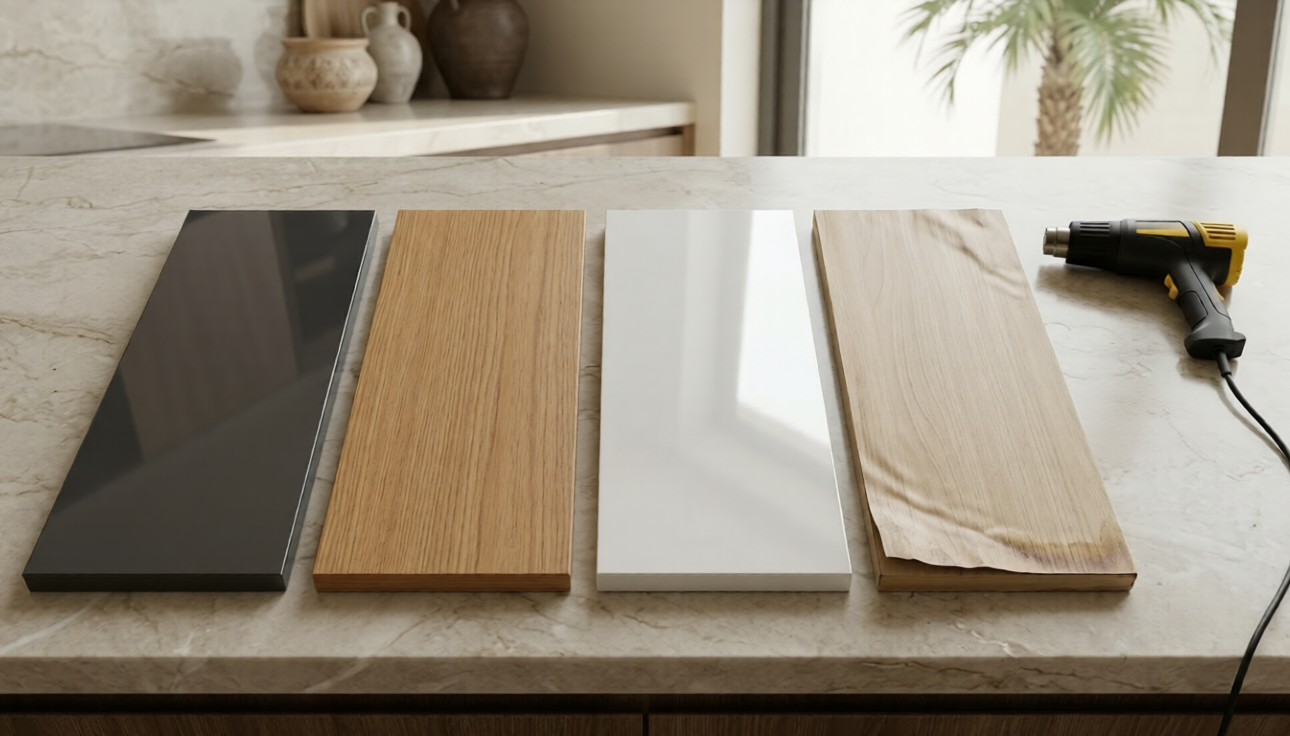
Lacquered MDF door fronts are the most popular choice in UAE villa kitchens. High-quality lacquer applied in a temperature-controlled environment is durable and consistent. It is susceptible to chipping at corners if impacted.
Veneer door fronts use real wood sliced into thin sheets, bringing natural material character and grain variation. They require correct sealing to prevent UV fading and moisture absorption.
High-gloss acrylic door fronts use a thick acrylic sheet, producing a mirror-bright finish. They are visually striking but scratch-sensitive and should be used selectively — typically on island units or feature sections rather than the entire kitchen.
Thermofoil and vinyl-wrapped door fronts are economical and practical, but quality varies significantly — low-quality thermofoil peels at edges in UAE heat conditions.
─── Ready to plan your project? Book a consultation with AL Banan Group