A walk-in closet designed for two people is a fundamentally different design challenge from one designed for one. The storage requirements are doubled. The usage patterns of two people — often with different getting-dressed schedules, different clothing volumes, different organisation preferences — must be accommodated without creating conflict over shared space.
The Case for Symmetrical Division
The most common source of dissatisfaction in shared walk-in closets is asymmetric space allocation. One person ends up with generous storage; the other is cramped. This imbalance is almost always planned-in at the design stage.
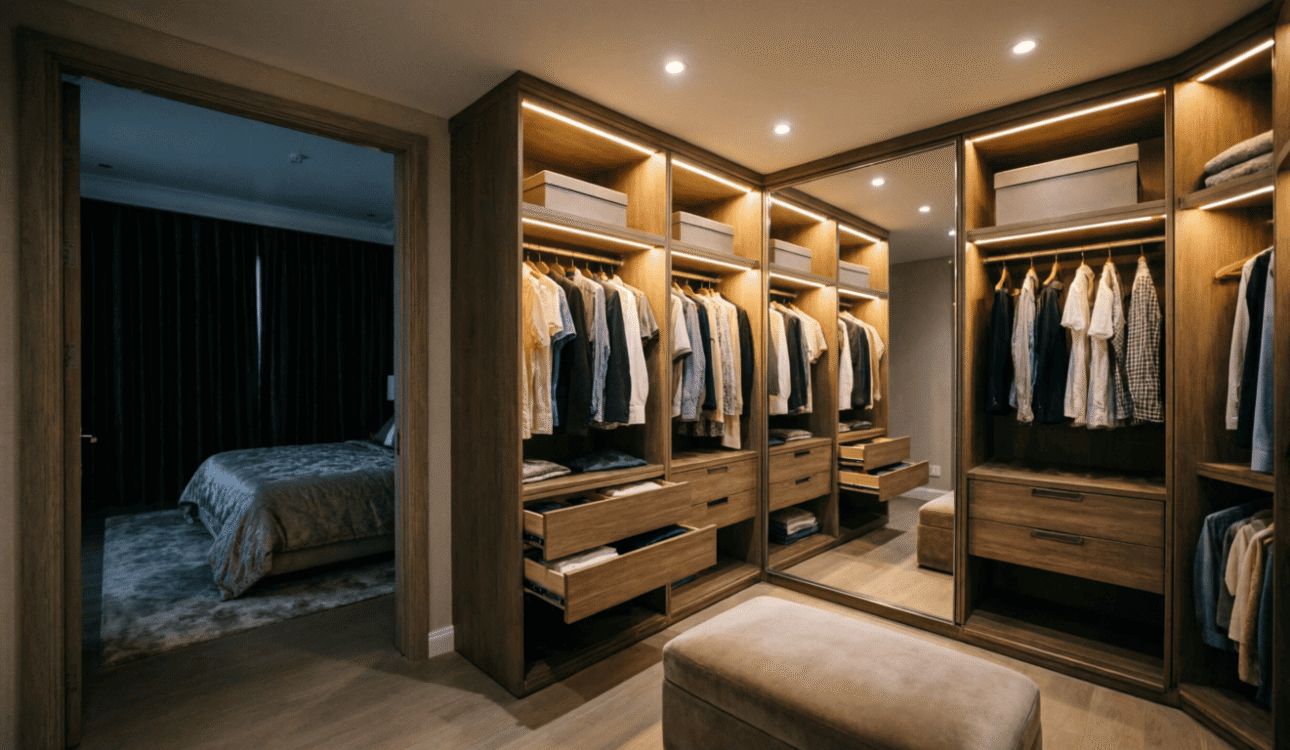
The cleanest solution is symmetric division: the available storage space is divided equally between two people, with each person’s section planned around their specific storage requirements. In a U-shaped or L-shaped walk-in closet, symmetric division is most naturally achieved by assigning each person a wall or a clearly defined wall section.
Separate Zones for Different Storage Categories
Not every storage category needs to be replicated twice. Shared sections work well for categories where usage is complementary rather than simultaneous — a shared island with drawer storage for accessories, shared open shelving for bags and luggage, shared floor space for a central bench. Sections that are used simultaneously — the hanging zone that is accessed during the morning getting-dressed routine — should be clearly separate for each person.
In UAE villa dressing rooms, the layout should allow both people to access their respective hanging and drawer sections without crossing through each other’s space.
Drawer Allocation
Drawers are the most contentious shared storage element in a two-person walk-in closet. The default configuration — a single bank of drawers shared between two people — works poorly because drawer organisation systems that work for one person’s habits rarely work for the other’s.
Two separate drawer towers — one for each person, positioned within their respective storage sections — are a much more functional solution. Each person organises their drawers independently without disrupting the other’s system. The cost of a second drawer tower is modest relative to the improvement in daily function.
Lighting and Getting the Conversation Right
A two-person walk-in closet requires lighting that serves both sections equally. Multiple ceiling downlights positioned to illuminate each section’s standing area, combined with LED strip lighting inside each person’s wardrobe sections, ensures both areas function equally well.
The best time to resolve allocation and organisation questions is before the design is drawn, not after it is installed. Before meeting with a wardrobe designer, both people should have a clear sense of: how much hanging space they need, how many drawers they use, how much shoe storage is required, and whether there are specific storage requirements for accessories or bags. This information takes fifteen minutes to gather and is far more valuable to the designer than a general aesthetic preference.