Walk into almost any hardware hypermarket or flat-pack furniture store in the UAE and you will find rows of kitchen cabinet units stacked in standardized widths — 400mm, 600mm, 800mm. The photography on the boxes looks polished. The price is lower than a custom quote. For a homeowner planning a kitchen renovation on the weekend, the appeal is obvious.
But there is a problem that does not show up in the photography.
UAE villas are not built to standardized dimensions. The wall between the kitchen and the dining room might be 2,340mm wide, not 2,400mm. The ceiling might be 2,650mm, not 2,400mm. The window sits at a position that no standard cabinet layout accounts for. The gas stub-out is 150mm off-centre from where a standard base unit would prefer it to be.
When you try to fit a standardized cabinet system into a non-standardized room, you end up with gaps. Fillers. Awkward transitions. A kitchen that looks acceptable in the showroom but looks cobbled together in your actual home.
The Fit Problem
Ready-made kitchen cabinets are designed for average rooms. The UAE does not have average rooms — it has villa layouts planned by individual architects, built by contractors who interpret those plans with varying precision, and handed over to homeowners who then try to fill the space with whatever is available in the market.
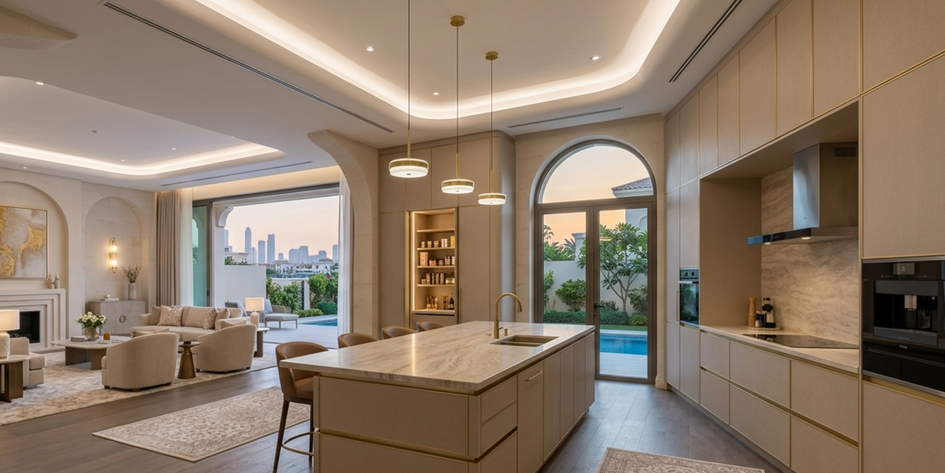
A custom cabinet system starts from your room’s actual dimensions. Every millimetre is accounted for. The cabinets run to the wall without gaps. The overhead units reach the ceiling without a floating gap above them, collecting dust. The corner solutions are designed for your specific corner angle and depth. The result looks like the kitchen belongs in the room rather than a room that has been made to accept a kitchen.
The Material Problem
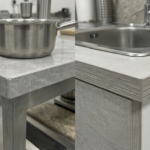
Ready-made kitchen cabinets sold in the UAE are commonly manufactured outside the region, using standard melamine-coated board without moisture-resistant treatment. In a UAE kitchen environment — where ambient temperatures can reach 45°C, steam from cooking is regular, and air conditioning cycles create humidity fluctuation — non-moisture-resistant board is a liability. Within two to three years, standard boards swell at the base of units near the sink, delaminate at door edges exposed to steam, and sag on long shelf spans under the weight of stored items.
Custom cabinets fabricated for UAE use specify moisture-resistant MDF or plywood carcasses from the outset. This is not a premium upgrade — it is the baseline specification for a kitchen cabinet that will last.
The Hardware Problem
Ready-made kitchen systems are almost always fitted with entry-level hinges and drawer runners. These are the components that determine how a kitchen feels every day — whether doors close cleanly, whether drawers open and close without effort, whether handles are aligned across all the doors. Entry-level hardware deteriorates within a few years of regular use. Hinges lose tension, drawer runners develop lateral play, and the small misalignments that develop over time make a kitchen feel old before it should.
Custom kitchen fabrication uses European soft-close hinges and undermount drawer runners as the standard specification. The difference in feel is immediate. The durability difference is measured in decades rather than years.
The Storage Problem
Standard kitchen cabinet interiors are exactly that — standard. A base cabinet is a box with a shelf. A drawer unit has drawers. There is no intelligent organization of storage around the way you actually cook, the specific appliances you own, the sizes of the containers you store in, or your household’s habits.
A custom kitchen design begins with a conversation about how you use the kitchen: what you cook, how often, for how many people, where you want things to be during cooking versus when they are stored, and what appliances need accessible locations versus storage. From that conversation comes a cabinet layout and internal configuration that supports your actual kitchen behaviour rather than forcing you to adapt to a generic one.
The Cost Equation Over Time
A custom kitchen costs more upfront than a ready-made system. This is a fact. But the relevant comparison is not the purchase price alone — it is the total cost over the kitchen’s expected life. A custom kitchen built with moisture-resistant carcasses, European hardware, and quality countertops should perform well for fifteen to twenty years with basic maintenance. A ready-made kitchen built with standard materials and entry-level hardware may require partial replacement or significant remediation within five to eight years in UAE conditions.
The annual cost of a well-specified custom kitchen is lower than that of a ready-made kitchen that needs replacing. That calculation does not account for the disruption and inconvenience of a kitchen replacement mid-occupancy.
What to Look for in a Custom Kitchen Supplier
If you are planning a custom kitchen in the UAE, the most important questions to ask a potential supplier are about fabrication: do they fabricate in-house or outsource? What carcass material do they specify as standard? What hardware brands do they use? Can they provide references or show photographs of installed projects similar to yours?
In-house fabrication matters because it means the supplier controls quality at the production stage, not just at the design and installation stages. When a cabinet is fabricated by a company you have never met to a specification your kitchen supplier passed on by telephone, the quality control is indirect and difficult to verify.
A kitchen designed, fabricated, and installed by a single company is the most coherent way to get a kitchen that performs as designed.
Ready to plan your project? Book a consultation with AL Banan Group